Descrição
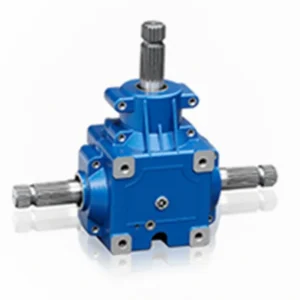
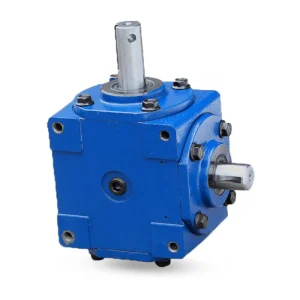
EP-L1005 Grain Storage Gearbox for Agricultural Grain Storage
A purpose-engineered grain storage gearbox built for the continuous, high-torque demands of silo unloaders, sweep augers, bucket elevators, and grain conveying systems. Constructed with HT250 grey iron housing and 40CrMnTi alloy steel gear shaft, the EP-L1005 delivers stable, low-speed power across the full range of grain storage facility equipment.
1. Technical Parameters — EP-L1005 Grain Storage Gearbox
The following parameters represent the engineering specification of the EP-L1005 under standard agricultural grain storage operating conditions. For non-standard applications or custom gear ratios, contact the technical team for a tailored specification review.
| Parameter | Valor / Especificação |
|---|---|
| Nome do produto | EP-L1005 Grain Storage Gearbox (L Series) |
| Application | Grain storage: sweep augers, silo unloaders, conveyors, bucket elevators, grain pumps |
| Mould No. | 6.5 |
| Material de Construção | HT250 grey cast iron (GB/T 9439) |
| Gear Shaft Material | 40CrMnTi alloy steel, quenched & tempered |
| Material da Engrenagem | 20CrMnTi carburized, case-hardened to 58–62 HRC |
| Tipo de Rolamento | Tapered roller bearings (GCr15 bearing steel) |
| Tipo de Engrenagem | Hardened helical / spur gears, finish-ground |
| Rated Input Speed | 960 / 1450 rpm (50 Hz motor) or 540 / 1000 rpm (PTO) |
| Faixa de velocidade de saída | 10–80 rpm (dependent on selected ratio) |
| Gear Reduction Ratio Options | 1:10 / 1:15 / 1:20 / 1:30 (custom ratios available) |
| Rated Output Torque | Up to 1,200 N·m (ratio-dependent) |
| Fator de Serviço | 1.5× (structural overload capacity) |
| Housing Surface Hardness (Brinell) | HT250: 170–241 HB |
| Shaft Seal Type | Double-lipped NBR shaft seals; anti-dust external lip |
| IP Protection Rating | IP65 (enhanced sealing for grain dust environments) |
| Sistema de Lubrificação | Splash lubrication, ISO VG 220 gear oil |
| Faixa de temperatura operacional | –10°C to +55°C (compatible with Brazilian tropical climate) |
| Surface Finish / Color | Phosphating + enamel coating; color customizable |
| Quality Certification | ISO 9001:2015; full material traceability per batch |
2. What Is the EP-L1005 Grain Storage Gearbox?
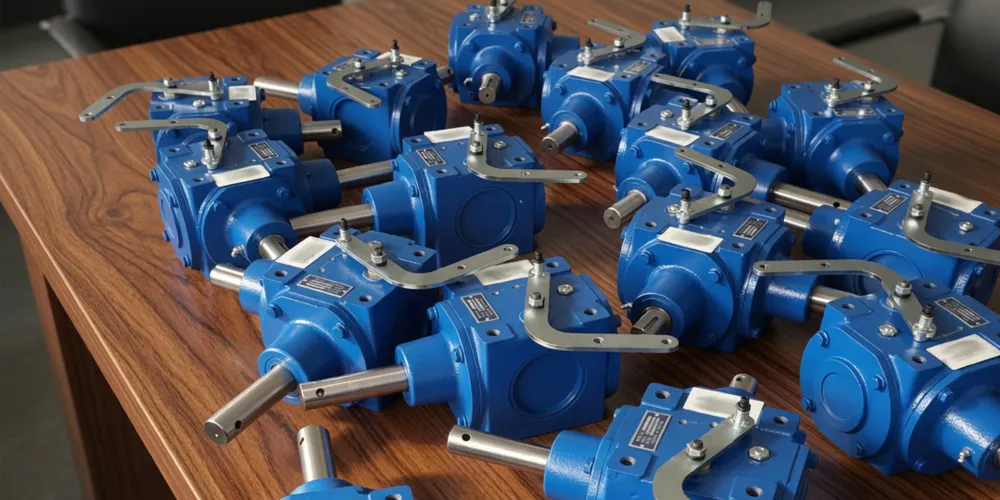
The EP-L1005 belongs to the L Series family of grain storage gearbox units — a product line developed specifically for the power transmission demands encountered inside grain storage facilities, not simply adapted from general-purpose industrial gearboxes. The distinction matters: grain storage environments present a unique combination of stressors that most standard gearboxes are not optimized for. Fine grain dust infiltrates seals, moisture condenses inside housings during temperature cycling, and abrasive particulates accelerate bearing surface wear far more aggressively than clean industrial environments. The EP-L1005 Grain Storage Gearbox addresses each of these failure modes through its material selection, sealing architecture, and internal lubrication design.
At its mechanical core, the EP-L1005 Grain Storage Gearbox is a gear reduction unit — it takes the relatively high rotational speed from an electric motor or tractor PTO and converts it into the lower-speed, higher-torque output required to drive sweep augers, drag chain conveyors, bucket elevator drives, and silo unloading mechanisms. These grain handling applications all share a common load characteristic: they need sustained torque at low speeds, with the ability to handle brief overload events when the equipment encounters a compacted grain mass or a bridged flow point. The EP-L1005’s gear reduction configuration and hardened 40CrMnTi shaft are sized to handle these load peaks without tooth deflection or shaft deformation.
Brazilian grain storage operators — particularly those managing large-scale soybean and corn storage in Mato Grosso and Paraná — increasingly specify the EP-L1005 Grain Storage Gearbox as both an OEM component and as a grain storage gearbox replacement parts solution when original gearboxes reach end-of-life. The standardized L-series mounting dimensions simplify installation in existing equipment without requiring platform modifications, and the customizable color and configuration options accommodate OEM branding requirements for equipment manufacturers integrating the gearbox into their product line.
3. Working Principle of Grain Storage Gearbox EP-L1005 Grain Storage Gearbox
Understanding the working principle of a grain storage gearbox starts with the power input stage. Mechanical power — either from a three-phase electric motor (common in fixed silo installations) or a tractor PTO output shaft (used in portable grain handling setups) — enters the EP-L1005 Grain Storage Gearbox through the input shaft. This shaft is connected via key-and-keyway or splined coupling to the primary drive gear inside the housing. As the input shaft rotates, the primary gear transmits torque to the driven gear set, which has a larger tooth count than the driver. This tooth-count difference is the fundamental mechanism behind gear reduction: the output shaft turns slower than the input, but at proportionally higher torque — exactly the output profile needed for grain auger and conveyor drives.
Inside the EP-L1005, the gear arrangement uses hardened spur or helical gears manufactured from 40CrMnTi alloy steel. Helical configurations offer quieter operation and smoother torque delivery compared to straight spur gears, which is an important consideration in permanently installed silo equipment where operator proximity is constant. The gear teeth are finish-ground after heat treatment to achieve precise tooth profile geometry, minimizing backlash and ensuring consistent output speed without hunting or oscillation — both of which would cause irregular auger sweep patterns and uneven grain flow. The output shaft transmits the conditioned power through a flange or coupling directly to the sweep auger, conveyor shaft, or bucket elevator drive sprocket.
Lubrication inside the EP-L1005 operates on a splash principle: the rotating gears carry oil from the sump to all gear mesh contact zones and bearing surfaces as they rotate. This eliminates the need for an external pump while ensuring adequate film formation at the contact interfaces. The oil sump is sealed by the HT250 housing assembly with precision-fit gaskets and double-lipped shaft seals, preventing both outward oil leakage and inward infiltration of grain dust and moisture. A breather vent regulates internal pressure changes caused by temperature cycling, preventing pressure-induced seal bypass — a common failure mode in silo environments where day-night temperature swings are large.
4. Materials & Construction Quality
Material selection for the EP-L1005 is driven by one primary engineering constraint: the gearbox must survive continuous operation inside environments where grain dust, moisture, and thermal cycling degrade components that would last for years in a clean industrial setting. The housing is cast from HT250 grey cast iron, a material specified under GB/T 9439 with a minimum tensile strength of 250 MPa and a Brinell hardness range of 170–241 HB. Grey cast iron’s natural graphite micro-structure provides excellent vibration damping — a meaningful advantage when the gearbox is mounted to a sweep auger or conveyor that generates constant cyclical loading from the grain mass. The graphite flake structure also offers inherent lubricity at casting surface contact interfaces, which contributes to reduced wear at the housing bore seats where bearings are pressed.
The gear shafts are machined from 40CrMnTi alloy steel — a chromium-manganese-titanium steel that is quenched and tempered to a core hardness of 28–34 HRC before finish machining. The titanium micro-alloying element refines the grain structure during heat treatment, producing a more uniform and fine-grained martensitic microstructure than plain chromium steels. This refinement translates directly into higher fatigue resistance under the reversed bending and torsional loads that shaft sections experience during agricultural grain storage operation. Gear elements are manufactured from 20CrMnTi alloy, carburized to case depth of 0.8–1.2 mm, then hardened to 58–62 HRC at the tooth surface while retaining a tough 28–35 HRC core. This dual-zone hardness profile prevents both the surface pitting that degrades soft gears and the brittle fracture that through-hardened gears are prone to under shock loads.
Housing — HT250 Grey Iron
Tensile strength 250 MPa, Brinell 170–241 HB; excellent vibration damping and casting machinability for precision bore tolerances
Gear Shaft — 40CrMnTi Alloy Steel
Quenched & tempered, core 28–34 HRC; titanium grain refinement improves fatigue resistance under torsional cycling
Gears — 20CrMnTi Carburized Steel
Case depth 0.8–1.2 mm, surface 58–62 HRC, core 28–35 HRC; finish-ground tooth profile for low backlash
Bearings — GCr15 Tapered Roller
H7 bore tolerance seat; handles combined radial + axial loads from auger and conveyor drives; rated for continuous grain storage duty cycle
Seals — Double-Lip NBR
Outer dust lip + inner oil lip; IP65-rated sealing assembly; resists grain dust, moisture, and petroleum-based gear oil
5. Key Internal Components
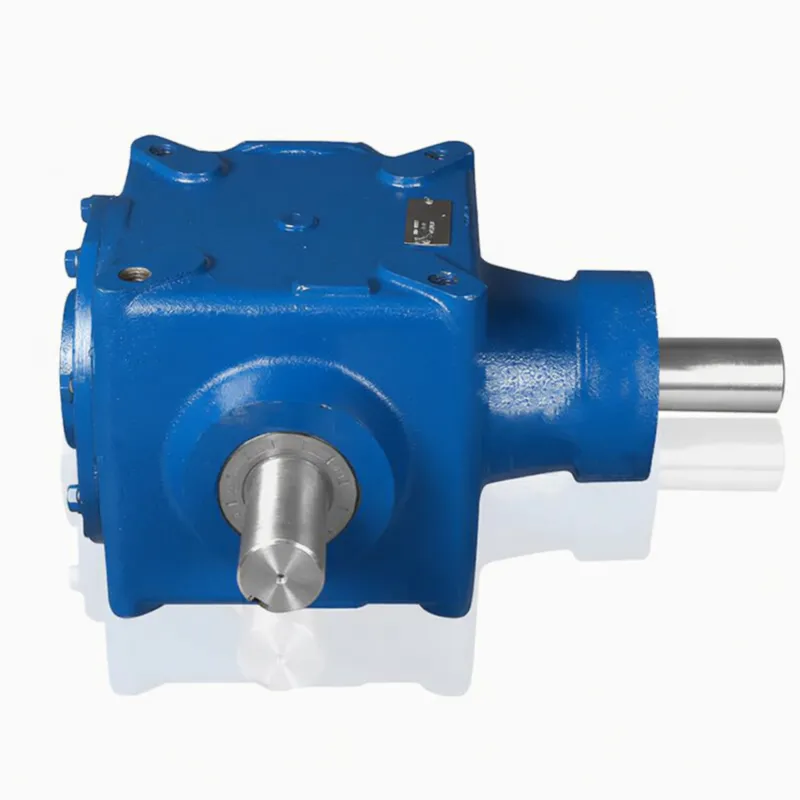
The EP-L1005’s performance as a grain storage gearbox depends on the correct interaction of six internal subsystems. Each is described below with the specific design choice that makes it suited to grain storage applications.
Housing (HT250 Cast Iron)
The cast housing encloses all rotating components in a rigid, precisely bored structure. Casting walls are dimensioned to absorb operational vibration without resonance amplification — important when the gearbox is mounted directly to thin-walled silo structures or portable conveyor frames.
Gear Set (Helical / Spur, 20CrMnTi)
The meshing gear pair provides the reduction ratio. Helical configurations are preferred for continuous-duty applications because the progressive tooth engagement reduces impact noise and distributes contact stress over a larger flank area. Gear tooth profiles are finish-ground after case hardening to AGMA quality level 10 or better.
Input / Output Shafts (40CrMnTi)
Both shafts are machined to h6/js6 diameter tolerance with keyway features per DIN 6885. The input shaft accepts standard motor coupling or PTO flange dimensions used on sweep auger drives across Brazilian and South American agricultural equipment platforms.
Tapered Roller Bearings (GCr15)
Tapered roller bearings handle the combined radial and thrust loads generated by helical gears under grain mass resistance. Bearing preload is set during assembly to the manufacturer’s specified axial clearance, preventing both premature fatigue and excess frictional heat generation during long harvest-season run periods.
Seals & Gaskets (NBR)
Double-lip NBR seals at each shaft exit point create a two-stage contamination barrier: the outer lip excludes grain dust and moisture, the inner lip retains gear oil. Housing split-face gaskets use cork-nitrile compound that remains compliant under temperature cycling between tropical heat and cool night conditions.
Lubrication System (Splash, ISO VG 220)
The rotating gears carry oil from the sump floor to the gear mesh zones and bearing contact surfaces with every rotation. The breather cap equalizes pressure differentials during heating and cooling cycles without allowing moisture or dust entry. Oil change is required annually or every 1,000 operating hours under standard conditions.
6. Five Key Advantages of the EP-L1005
The L-series gear reduction design delivers high output torque at the low rotational speeds required by sweep augers and drag chain conveyors — equipment that must move dense grain mass smoothly without surge or stall. This is the fundamental performance characteristic that defines a purpose-built grain storage gearbox versus a repurposed general industrial unit.
Double-lipped NBR shaft seals and precision-fitted housing gaskets achieve IP65 protection — the rating that qualifies the EP-L1005 for use in environments where grain dust and condensation are unavoidable. This sealing architecture prevents the contaminated-lubricant failures that are the leading cause of grain storage gearbox replacement in silo operations.
The EP-L1005 is dimensionally compatible with sweep augers, bucket elevators, horizontal drag chain conveyors, grain pumps, and aeration fan drives — covering essentially the complete range of grain storage equipment types. A single gearbox platform that spans the full facility reduces spare parts inventory requirements and simplifies maintenance scheduling for facility operators managing large storage complexes.
Splash lubrication with ISO VG 220 gear oil, sealed bearing pre-greasing at assembly, and self-cleaning seal lips combine to extend maintenance intervals to 1,000 operating hours between oil changes and bearing inspections. This low-maintenance characteristic is particularly valuable during harvest season, when downtime of grain receiving and storage equipment directly translates to crop loss and logistics disruption.
Finish-ground helical gears achieve transmission efficiency above 96% per gear stage — significantly better than the 92–94% typical of unground spur gear configurations. For permanently installed grain facility equipment running 8–16 hours per day during peak season, this efficiency difference translates to meaningful savings on electricity bills over the course of a harvest period.
7. Application Scenarios
The EP-L1005 grain storage gearbox is deployed across a broad range of grain handling equipment types, from small on-farm bin systems to large commercial grain elevators processing hundreds of tonnes per day.
Silo Sweep Augers
Sweep augers rotate around the perimeter of the silo floor, pushing grain toward the central discharge point. The EP-L1005 provides the torque necessary to drive the auger through compacted grain layers without stalling — a common failure point for undersized gearboxes. In Brazilian commercial silos storing soybeans and corn, sweep augers equipped with the EP-L1005 achieve consistent floor cleanout without the grain quality damage caused by abrasive auger contact when the equipment surges or vibrates. The grain storage gearbox working principle here relies on sustained, steady torque output rather than peak speed — exactly the EP-L1005’s operating strength.
Silo Unloaders
Unloading mechanisms — both bottom-draw and overhead cable types — depend on gearbox-controlled speed to manage grain flow rate from the silo into receiving pits or transport vehicles. The EP-L1005’s adjustable gear ratio options allow facility operators to match the unloading rate precisely to the capacity of downstream handling equipment, preventing overloading of conveyors or receiving pits. This is a critical function during the Brazilian harvest rush when truck turnaround time at grain terminals is tightly constrained.
Horizontal Drag Chain Conveyors
Drag chain conveyors move grain horizontally between storage structures and to loading stations. The EP-L1005 drives the head shaft of these conveyors through a flange coupling or sprocket arrangement, providing the consistent, controlled speed that prevents grain bunching, chain derailment, and spillage. Its energy efficiency rating above 96% per stage is particularly relevant here, since conveyor drives run for extended periods during receiving season.
Bucket Elevators
Vertical bucket elevators lift grain from receiving pits to the tops of storage structures — often lifting 20–40 metres in large commercial grain complexes. The EP-L1005 gearbox must manage the combined weight of the bucket chain, the grain load in each bucket, and the starting torque requirement of lifting against gravity. The 1.5× service factor in the EP-L1005 specification directly addresses this challenge, providing structural capacity above the rated load for reliable start-up under full bucket load conditions.
Grain Pump Systems
Chain-and-flight grain pump systems move grain through enclosed tubes at constant, controlled velocity. Consistency of flight chain speed is critical — any speed variation causes grain bridging inside the tube or grain breakage at the discharge bend. The EP-L1005’s low-backlash gear mesh maintains output shaft speed stability across the full range of grain mass loading, from empty-tube startup to full-load continuous operation.
Aeration Fan Drives
Aeration fans in grain storage bins maintain the correct temperature and moisture gradients to prevent hotspot formation and mycotoxin development. The EP-L1005 can drive fan shaft assemblies requiring precise speed control across a range of reduction ratios, ensuring that airflow rates remain within the agronomically defined ranges for the specific grain type and storage conditions prevalent in tropical and subtropical Brazilian storage environments.
8. Common Troubleshooting & Maintenance
Knowing how to identify and respond to early-stage gearbox issues prevents escalation to major failures. The following covers the most common problems encountered with grain storage gearbox equipment in active facility operation.
Excessive Noise or Vibration
Usually indicates misalignment, bearing degradation, or chipped gear teeth. First check and correct the mounting alignment against the motor shaft. Inspect bearings for pitting or spalling by listening for a characteristic rumble during operation. If gear noise is a grinding or crunching quality, inspect tooth surfaces for chipping at the next oil change.
Overheating Housing
A housing surface temperature above 70°C under steady-state operation indicates either insufficient oil level, a blocked breather vent causing pressure-driven oil bypass, or operational overloading above the rated torque. Check oil level first, then verify breather cap is unobstructed. If overloading is suspected, review the grain density and equipment capacity versus the gearbox specification.
Oil Leakage at Shaft Seals
Seal lip wear or hardening is the most common cause. Inspect the shaft running surface for scoring — a worn shaft groove requires shaft sleeve repair before a new seal will hold. Replace both seals (input and output) simultaneously when replacing one, as the second is likely close to the same service life. Always clean the shaft surface with fine emery cloth before fitting new seals.
Contaminated Gear Oil
Milky or grey oil indicates water or metal particle contamination respectively. Water contamination requires seal replacement and full oil change with system flush. Metallic particle contamination (grey or silver-flecked oil) indicates internal wear in progress — drain, inspect gears and bearings, replace worn components, then refill with fresh ISO VG 220 before returning to service.
9. Regulatory Framework & Industry Standards
Grain storage gearboxes installed in agricultural grain handling facilities are subject to regulatory requirements that vary by country. Buyers sourcing grain storage gearbox parts or complete units should verify that the gearbox specification meets the standards applicable in their operating jurisdiction.
| Region | Standard / Regulation | Relevance to Grain Storage Gearbox |
|---|---|---|
| Brazil | NR-12 (Machinery & Equipment Safety) — MTE Resolution | Guards on rotating shafts and gear drives in grain handling equipment; lockout-tagout procedures during gearbox maintenance |
| Brazil | ABNT NBR 7094 — Industrial Gearbox Standards | Dimensional and performance requirements for industrial gear reducers; informs torque rating and mounting pattern standardization |
| EU | Machinery Directive 2006/42/EC; EN ISO 11684 (Safety signs on agricultural machinery) | CE marking required for grain handling machinery; safety labeling on power take-off and gear drive components |
| EUA | OSHA 29 CFR 1910.217 (Mechanical Power Transmission); AGMA 9005 (Industrial Gear Lubrication) | Guarding requirements for exposed gears and shafts; lubrication standards referenced for grain storage drive gearbox selection |
| International | ISO 9001:2015; ISO 6336 (Gear Load Capacity Calculation) | Manufacturing quality system; torque rating calculation methodology for grain storage gearbox design verification |
| Argentina | Resolución 295/03 MTESS (Ergonomics and Equipment Safety) | Relevant to maintenance access requirements for grain storage gearbox installation in silo facilities used in Argentine grain-producing provinces |
10. About Us
We are an ISO 9001:2015-certified manufacturer specializing in agricultural power transmission equipment — including the full range of grain storage gearboxes, agricultural conveyor drives, tractor PTO gearboxes, and rotary tillage transmission systems.
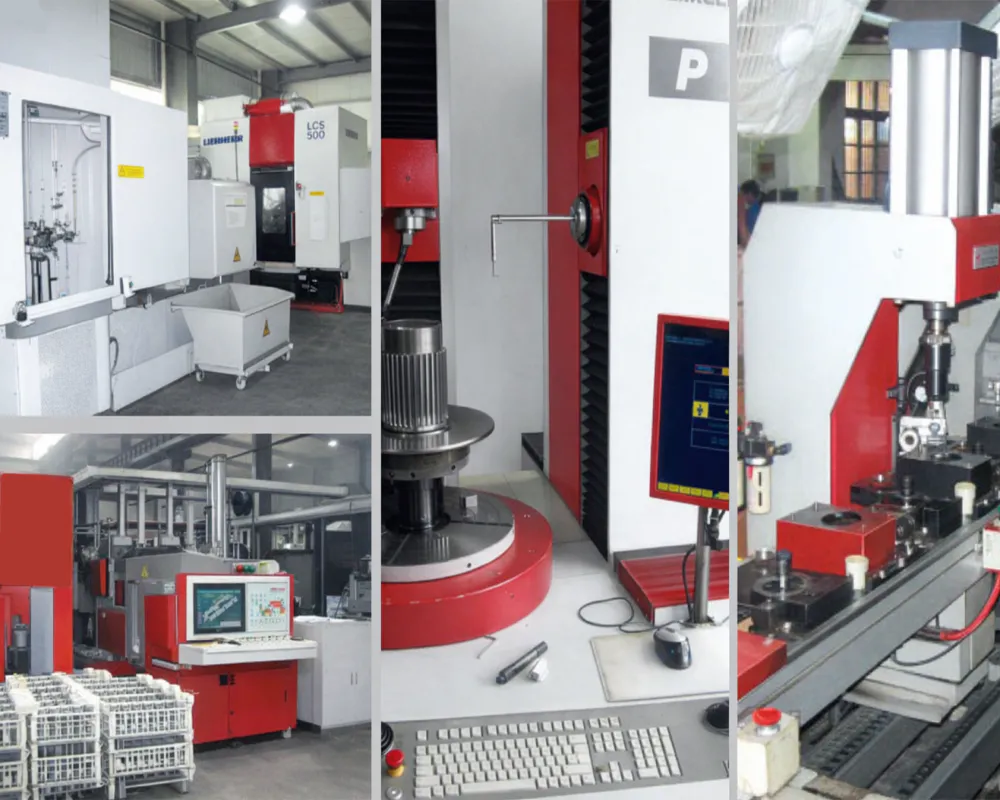
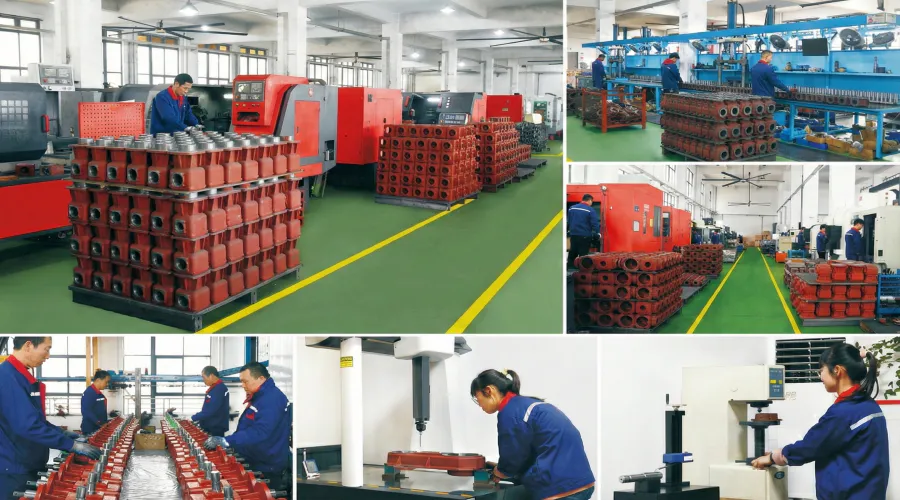
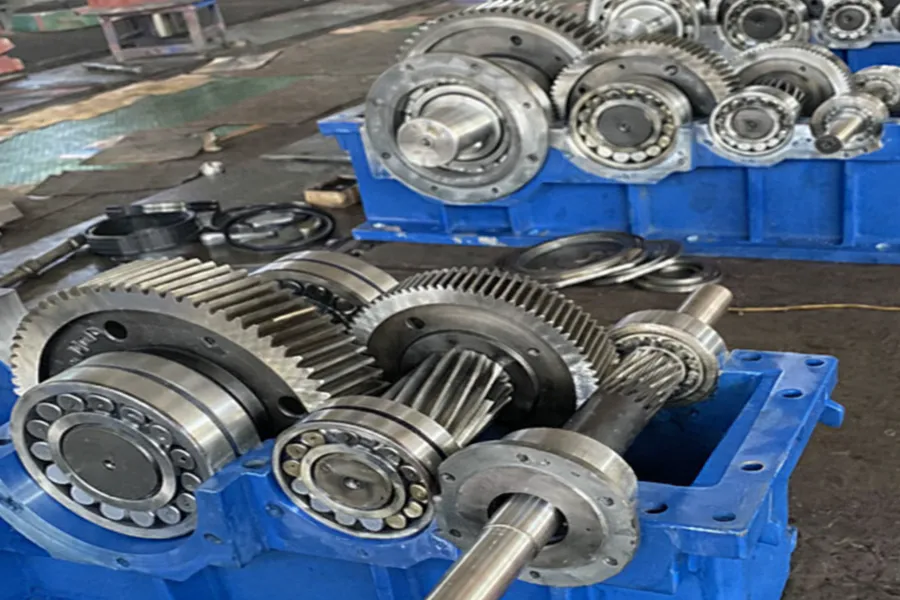
Our production process covers the complete manufacturing chain: steel procurement with material certification, CNC gear hobbing and profile grinding, in-house heat treatment with hardness verification, housing boring to H7 tolerance, assembly in controlled conditions, and final oil pressure testing before shipment. Each EP-L1005 unit leaves our facility with batch-level material traceability documentation, making it straightforward for OEM customers to maintain their own component certification records. We supply both OEM grain handling equipment manufacturers integrating the EP-L1005 into new machines, and aftermarket customers sourcing grain storage gearbox replacement parts for existing silo equipment.
WorkShop
11. Related Products — One-Stop Agricultural Drivetrain Supply
Maximizing uptime in grain storage operations requires that every component in the drivetrain — from tractor PTO output to gearbox to conveyor shaft — is properly matched in specification. We manufacture the full system of complementary components alongside our grain storage gearboxes, offering true one-stop supply capability that simplifies procurement and guarantees compatibility.
PTO Shafts for Grain Handling Equipment
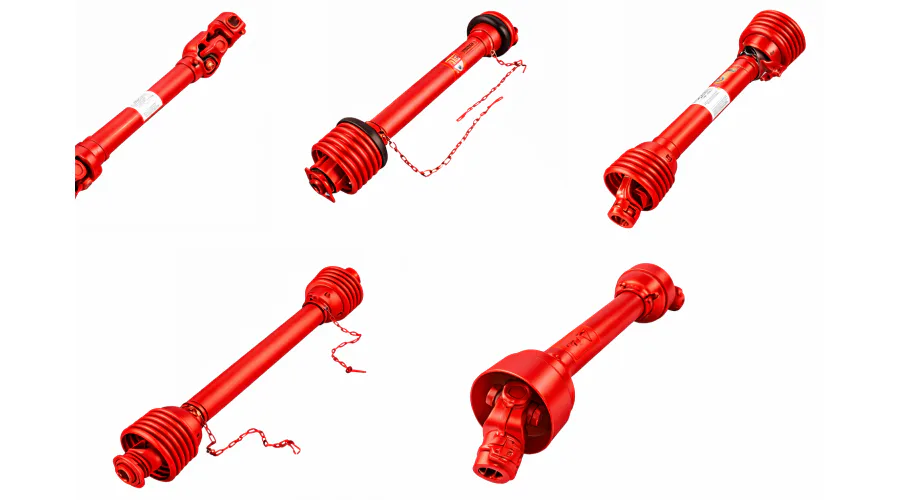
When the EP-L1005 is driven from a tractor PTO rather than a fixed electric motor — as is common in portable sweep auger systems and field-side grain moving setups — the PTO shaft connecting the tractor and gearbox is as critical as the gearbox itself. Undersized PTO shafts flex under load, generating vibration that accelerates bearing wear inside the gearbox. We supply agricultural PTO shafts in the full range of cross joint sizes, with torque limiter and overrunning clutch options matched to the EP-L1005’s rated input torque. All shafts are dimensionally compatible with the Φ35, Φ40, and Φ45 mm input shaft configurations common across grain handling platforms in Brazil and Argentina.
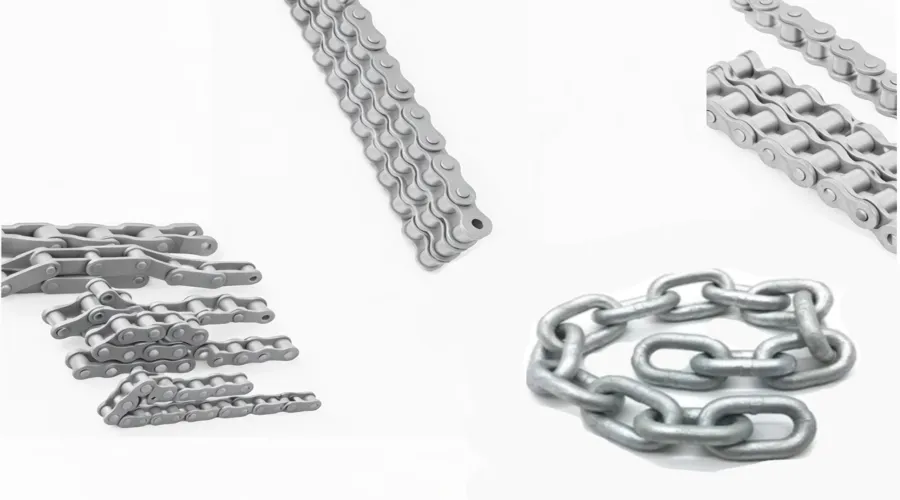
Roller Chains & Agricultural Sprockets
Grain conveyor chains and bucket elevator chains are downstream of the gearbox in the power transmission path, and their wear rate directly determines overall system maintenance intervals. Our ISO 606 / DIN 8187-compliant roller chains and matching sprocket sets are manufactured with grain-compatible surface treatments — non-toxic coatings that prevent grain contamination while resisting the abrasive wear that accelerates chain elongation in grain dust environments. Matching our chains and sprockets with the EP-L1005 gearbox ensures that the entire drive train is rated to the same duty cycle, eliminating the weakest-link failure modes that occur when components from different quality tiers are combined.
Frequently Asked Questions
Editor: PXY