
Descrição
1. EP-TBS128 Grader Driven Rake Gearbox Technical Specifications
| Parameter | Specification |
|---|---|
| Model Number | EP-TBS128 Grader Driven Rake Gearbox |
| Gearbox Type | Two-Speed Helical Bevel Drive |
| Gear 1 Ratio | 3.69 : 1 (reduction) |
| Gear 2 Ratio | 2.81 : 1 (reduction) |
| Velocidade de entrada | 2400 RPM |
| Output Speed (Gear 1) | 650 RPM |
| Output Speed (Gear 2) | 850 RPM |
| Nominal Power | 80 HP (59.7 kW) |
| Maximum Power | 100 HP (74.6 kW) |
| Toothing Type | Gleason Helical Teeth |
| Material da Engrenagem | 20CrMnTi Alloy Steel, Carburized |
| Dureza da Superfície | HRC 58–62 |
| Dureza do Núcleo | HRC 33–38 |
| Material de Construção | Gray Cast Iron HT250 (GB/T 1348-2009) |
| Tipo de Rolamento | Tapered Roller Bearings, 30200 Series |
| Bearing L10 Life | >5,000 hours at rated load |
| Input Shaft | 32 mm diameter, splined interface |
| Eixo de Saída | 45 mm diameter, Key 14 × 9 mm |
| Lubrificação | 80W-90 GL-5 Gear Oil, Splash Feed |
| Oil Capacity | 1.5 L |
| Temperatura operacional | -20°C a +85°C |
| Protection Rating | IP54 (dust-protected, splash-resistant) |
| Overall Dimensions (L × W × H) | 385 mm × 248 mm × 272 mm |
| Net Weight | 32 kg |
| Gear Accuracy Grade | AGMA Class 10 / DIN Grade 6 |
| Noise Level (Rated Speed) | ≤ 72 dB(A) |
All values reflect the standard production specification. Bespoke configurations with different ratios, shaft dimensions, and flange patterns are available for OEM integration.
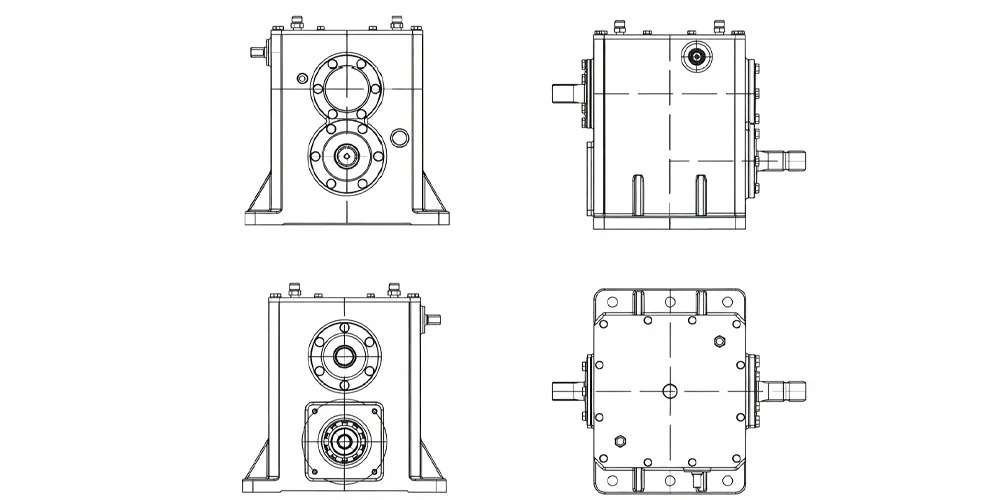
2. Fast Facts – EP-TBS128 Two-Speed Grader Driven Rake Gearbox
● Two-Gear Ratios: 3.69:1 (slow/high-torque) and 2.81:1 (fast/lower-torque) – operator selectable
● Input Speed: 2400 RPM from crawler tractor output / Output: 650 or 850 RPM
● Power Rating: 80 HP nominal (59.7 kW) / 100 HP maximum (74.6 kW)
● Tooth Geometry: Gleason helical teeth for quieter running and higher load capacity
● Host Equipment: Crawler (tracked) rotary cultivators and specialty tillage implements
3. What Is a Grader Driven Rake Gearbox and Why the EP-TBS128 Suits Crawler Cultivators?
Crawler rotary cultivators occupy a different mechanical world than their wheeled cousins. Because the tracks deliver higher drawbar pull with lower ground pressure, these machines are typically deployed on soft, wet, or hillside terrain where wheeled tractors would bog down or compact the subsoil beyond recovery. That operating reality places unusual demands on the driveline behind the cultivator head: rotor speed must remain stable as the machine crawls over uneven ground, the gearbox has to tolerate shock loads when tines strike buried rocks or root masses, and the entire transmission needs to fit into a tight, low-profile implement frame typical of tracked equipment. The EP-TBS128 Grader Driven Rake Gearbox was engineered specifically against these constraints. Its two-gear design – ratios of 3.69:1 and 2.81:1 – gives operators a practical choice between higher torque at slower rotor speed for heavy soil and wet clay, or faster rotor speed at reduced torque for dry, friable seedbeds where productivity matters more than raw cutting force. That flexibility is why Brazilian cooperatives working the paddy-adjacent lowlands of Santa Catarina and the hilly coffee zones of Minas Gerais often ask for this specific model when specifying a new rotary cultivator build.
Anyone asking what is a Grader Driven Rake Gearbox in plain mechanical terms should think of the component as a right-angle power converter with ratio control. On the input side, rotational energy arrives at 2400 RPM from the crawler tractor’s high-speed output or a geared intermediate drive. Inside the housing, two pairs of helical gears sit ready to be engaged – only one pair carries torque at a time – and a simple shift collar selects which pair is coupled to the output shaft. The output then drives the cultivator’s rake or tine rotor through a splined or keyed interface. The Gleason helical tooth form provides two advantages over straight bevel designs: gradual tooth engagement that reduces noise and shock, and higher load capacity per unit of tooth width because more teeth share the load at any given moment. This makes the EP-TBS128 Grader Driven Rake Gearbox a popular grader driven rake gearbox for rotary tillers and crawler cultivators alike where sustained heavy-load work is the norm rather than the exception.
4. Five Key Advantages of the EP-TBS128 Rake Gearbox
1. Two-Speed Selectability Matches Soil Conditions
Having two selectable gear ratios in one housing is the defining feature of this model and the main reason to pick it over single-speed alternatives. Gear 1 at 3.69:1 delivers 650 RPM at the output with maximum torque – the right choice for heavy clay, wet rice paddies after drainage, or fields with significant residue load. Gear 2 at 2.81:1 gives 850 RPM with less torque but higher productivity, suited to drier loams where the rotor does not need to chew through compacted layers. Operators switching between these two ratios can optimize fuel burn, implement wear, and finished seedbed quality across a full working day where conditions shift as the sun rises and the soil dries.
2. Gleason Helical Teeth Reduce Noise and Vibration
The Gleason helical tooth form was selected deliberately for this gearbox. Compared to straight-cut teeth, helical teeth engage gradually across their face width, which means at any instant multiple teeth share the torque load. The result is measurably quieter operation – typically 4 to 6 decibels lower at rated speed – and noticeably less vibration transmitted into the implement frame. For crawler cultivator operators spending 8 to 10 hours a day behind the controls, that reduction matters for operator fatigue. It also means bearing loads are smoother, which extends bearing life and reduces the frequency of service interventions across the gearbox’s working life.
3. Housing Designed for Dirty, Wet, Debris-Heavy Work
Crawler cultivation often happens in conditions wheeled tractors avoid entirely – rice-paddy drainage events, spring-thaw fields where the ground is still saturated, coastal alluvial plots exposed to brackish spray. The EP-TBS128 Grader Driven Rake Gearbox housing reflects these realities: a machined two-piece cast-iron shell with double-lip NBR shaft seals, an external breather filter to prevent dust ingress during pressure cycling, and generous oil sump volume so the lubricant stays cool even during extended heavy work. External paint is an agricultural-grade two-coat epoxy system rated for UV, moisture, and light chemical exposure. These choices are why the EP-TBS128 retains its function-and-finish integrity after multiple seasons in the field, rather than rusting out or weeping oil within a single year.
4. Carburized 20CrMnTi Gears Survive Shock Loads
Tillage shock loads are unavoidable – every buried stone, root mass, or compacted clod sends an impact pulse up through the cultivator rotor, into the output shaft, and through the gear mesh. An under-specified gear material will pit, crack, or shear its teeth under these conditions within a single cropping season. The EP-TBS128 Grader Driven Rake Gearbox uses 20CrMnTi alloy steel gears, gas-carburized to a 0.8 to 1.2 millimeter case depth, then oil-quenched and low-temperature tempered. The resulting tooth has HRC 58 to 62 surface hardness with a tough HRC 33 to 38 core, the combination engineers specify when they need both pitting resistance and shock tolerance in the same component. This why choose a grader driven rake gearbox question often comes down to gear metallurgy more than any other single factor.
5. Documented Compliance Package for Export Markets
Every EP-TBS128 Grader Driven Rake Gearbox leaves the facility under an ISO 9001:2015 quality management regime, with gear geometry verified on coordinate measuring machines and each finished unit loaded-run-in tested. For Brazilian importers, the documentation package includes installation, operation, and maintenance manuals in Portuguese as required by NR-12 (Norma Regulamentadora 12), plus guarding references aligned with ABNT NBR ISO 13855 safety-distance calculations. For EU customers, the design references ISO 12100 risk-assessment methodology that supports CE marking under Machinery Directive 2006/42/EC. This multi-standard groundwork minimizes the certification work distributors have to do downstream.
5. How the EP-TBS128 Grader Driven Rake Gearbox Works – Step by Step
Understanding how grader driven rake gearbox works on a crawler cultivator starts with the power source. Unlike wheeled tractors using a 540 RPM rear PTO, crawler rotary cultivators typically take their power from a higher-speed output – in this case 2400 RPM – often delivered through a short driveshaft from the crawler’s transmission or a mid-mounted auxiliary drive. This shaft couples to the input shaft of the EP-TBS128 Grader Driven Rake Gearbox, which enters the gearbox housing supported on a pair of tapered roller bearings. Inside the housing, two helical pinions are mounted on the input shaft – one sized for the 3.69:1 ratio and one sized for 2.81:1. Each pinion is permanently meshed with its matching helical gear on the countershaft or output shaft, but only one gear pair transmits torque at a time. A dog clutch or synchronized shift collar determines which pair is engaged, giving the operator a clear two-position selector.
When the operator selects gear 1 – the slow, high-torque setting – the dog clutch locks the 3.69:1 pair to the output, and the rotor spins at 650 RPM. The gear pair is chosen because it offers maximum torque multiplication, ideal for heavy clay or wet, root-bound soils. Selecting gear 2 switches power through the 2.81:1 pair, dropping the ratio and speeding the rotor up to 850 RPM. This is the productivity setting used when the soil is friable, the field is clear, and the operator wants the maximum coverage per hour. Throughout operation, the helical tooth form smooths the transition – gradual tooth engagement means torque is delivered as a continuous flow rather than a series of shocks. The gear oil in the sump cools the meshing zones through splash circulation, carrying heat to the housing walls where it radiates to the surrounding air. The operator retains complete control through the PTO clutch at the tractor end: disengaging the clutch stops input rotation instantly, and the rotor’s low rotational inertia lets the gearbox coast to a stop within a few seconds. That is how grader driven rake gearbox works step by step in this specific two-speed architecture.
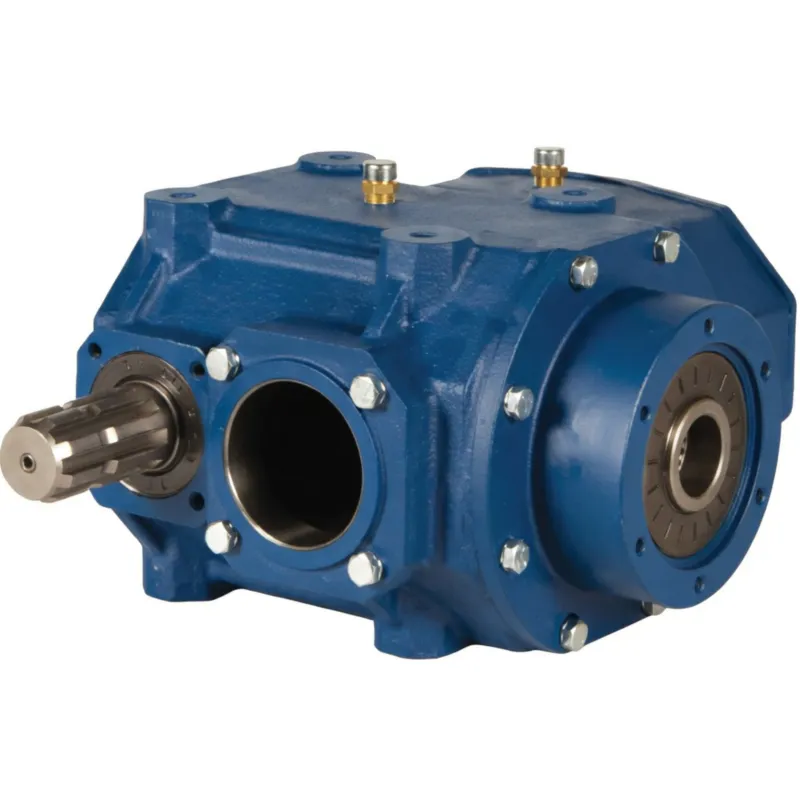
6. Materials and Metallurgy Inside the EP-TBS128 Grader Driven Rake Gearbox
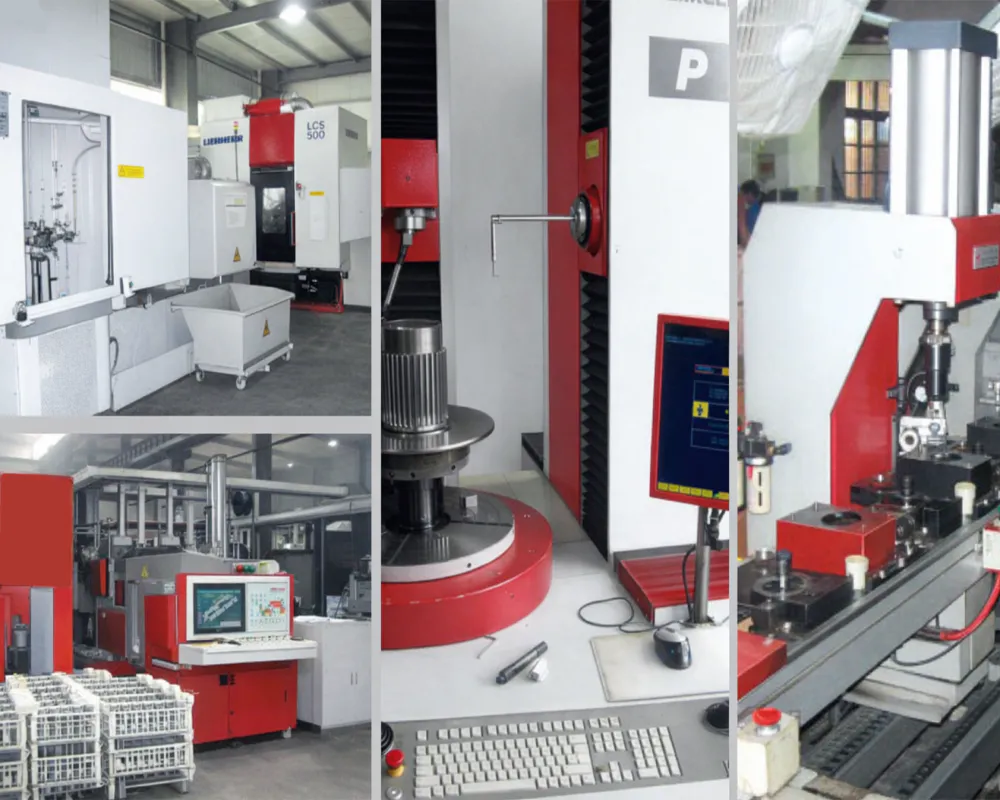
The gear pairs in the EP-TBS128 are machined from 20CrMnTi chromium-manganese-titanium alloy steel – the workhorse metallurgy of agricultural bevel-gear transmissions. Raw forgings are turned and hobbed on dedicated helical gear generators, then transferred to gas carburizing furnaces running at approximately 920°C. The carburizing cycle builds a carbon-enriched case between 0.8 and 1.2 millimeters deep, which is then oil quenched and low-temperature tempered. This sequence produces the characteristic dual-hardness profile agricultural designers rely on: a very hard surface (HRC 58-62) that resists pitting and abrasive wear, paired with a tough, ductile core (HRC 33-38) that flexes and absorbs shock loads without cracking. Before final assembly, each gear passes through CMM inspection where tooth profile, lead angle, and runout are verified against engineering drawings – values outside tolerance are reground or rejected.
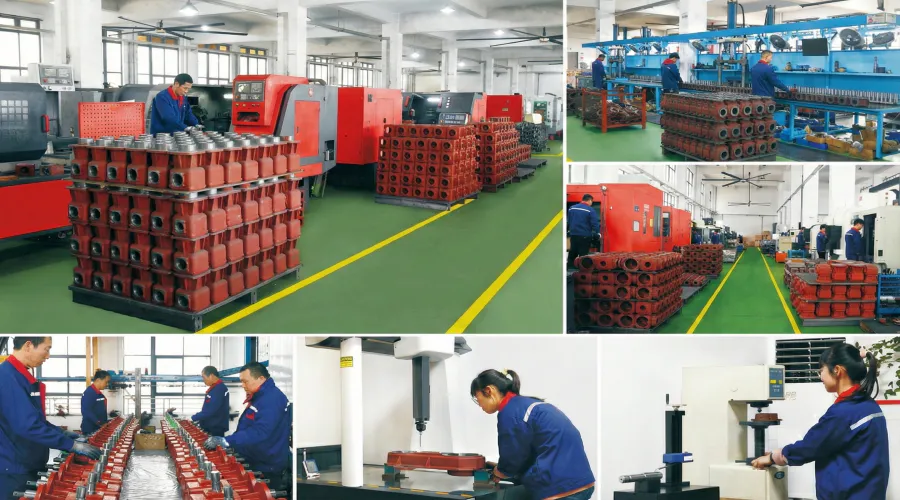
The two-piece housing is sand-cast from HT250 gray iron conforming to Chinese national standard GB/T 1348-2009, then machined on horizontal CNC machining centers to hold bearing bore alignment within 0.05 millimeters across the full shaft span. Gray iron is the material of choice here for three practical reasons: excellent vibration damping thanks to the graphite flakes in its microstructure, forgiving machinability that allows precise bearing-seat finishing without specialized tooling, and dimensional stability under the sustained bolt clamping loads at the flange joint. Shaft seals are double-lip NBR (nitrile butadiene rubber) designed for compatibility with API GL-5 gear oil and continuous service up to 100°C. All external fasteners are property-class 10.9 alloy steel, and the housing exterior receives a sand-blasted profile followed by high-build epoxy primer plus agricultural topcoat for long-term corrosion resistance in humid, tropical Brazilian conditions.
7. Field Applications for the EP-TBS128 Grader Driven Rake Gearbox
Seedbed Preparation on Heavy Clay Soils
Gear 1’s lower rotor speed of 650 RPM combined with maximum torque output is the right choice when crawler cultivators work heavy clay soils typical of Brazil’s São Paulo interior and the Santa Catarina lowlands. At this slower rotor speed, the tines get time to actually cut through compacted clay layers rather than glancing off them, producing a properly fractured seedbed that holds moisture and accepts seed at uniform depth. Operators report that switching to gear 1 on clay-rich sections of a field significantly reduces the need for secondary passes with harrows or rollers, which saves diesel and cuts compaction from repeated wheel traffic.
Weed Control and Mechanical Cultivation
Gear 2 at 850 RPM shines in weed-control operations between crop rows, where the cultivator needs to work shallow, chop up young weeds quickly, and move through the field at respectable ground speed. The faster rotor speed produces a cleaner cut on weed stems and reduces the risk of roots re-establishing in the disturbed soil. This application is increasingly important in Brazilian organic vegetable operations and vineyard row-middle management across Europe, where herbicide-free cultivation is either legally required or commercially preferred.
Crop Residue Incorporation and Conservation Tillage
After maize, sorghum, or sugarcane harvest, fields are left with significant residue loads that must be incorporated into the soil to release nutrients and prepare the ground for the next crop. The EP-TBS128 Grader Driven Rake Gearbox in gear 1 gives cultivators the torque they need to chop and bury dense residue without stalling, supporting conservation tillage practices that minimize soil disturbance while still producing a plantable surface. This residue handling is particularly important across Brazil’s sugarcane belt where burning-off is increasingly restricted and green-harvest residue must be mechanically incorporated instead.
Specialty Crop and Vegetable Bed Preparation
Vegetable operations, specialty crops, and horticultural nurseries routinely need finely worked planting beds with precise depth control and uniform soil texture. The two-speed EP-TBS128 Grader Driven Rake Gearbox lets growers match rotor speed to the specific crop requirements: lower speed for deep-rooted tomatoes or carrots in heavier soils, higher speed for shallow-rooted leafy greens in lighter substrates. This flexibility is why the EP-TBS128 appears regularly in the grader driven rake gearbox for rotary tillers segment used by small-holder vegetable producers in Rio Grande do Sul, Paraná, and the São Paulo horticultural belt.
8. Regulatory Landscape and International Compliance
Brazil’s NR-12 (Norma Regulamentadora 12) is the dominant machinery safety regulation to consider for this product. Administered by the Ministry of Labor and enforced through on-site labor inspections, NR-12 covers the full lifecycle of industrial and agricultural machinery: design, manufacturing, importation, sale, installation, operation, and decommissioning. For a crawler cultivator gearbox, the practical NR-12 touchpoints include Portuguese-language technical documentation covering installation and maintenance (per clause 12.128), appropriate safety labeling on the product itself, guard mounting provisions that allow end-users to meet ABNT NBR ISO 13855 safety-distance requirements for rotating components, and risk assessment records aligned with ISO 12100 methodology. Failure to meet NR-12 exposes the equipment owner to labor-inspector embargo of the machine and administrative fines ranging from R$2,000 to over R$200,000 per unit. INMETRO (the National Institute of Metrology) may require product-specific certifications depending on final equipment category.
Beyond Brazil, each major destination has its own framework. The European Union Machinery Directive 2006/42/EC mandates CE marking for agricultural equipment, supported by a conformity assessment following ISO 12100 risk assessment, ISO 6336 gear load capacity calculation, and AGMA 2003 bevel gear rating standards. The United States applies OSHA 29 CFR 1910.147 machine guarding rules and ANSI/ASABE S318 for agricultural equipment shielding. Canada follows CSA Z432 machinery safety standards with provincial enforcement variations. Australia works under AS 4024 series safeguarding standards. Argentina uses IRAM standards closely paralleling ISO references. The EP-TBS128 Grader Driven Rake Gearbox is designed with explicit reference to ISO 12100, ISO 6336, and AGMA 2003 from the start – a technical foundation that dramatically shortens the certification work distributors face when introducing the product to their home market.
9. Installation and Maintenance Guidance
Installation of the EP-TBS128 Grader Driven Rake Gearbox begins with mechanical fit verification: confirm the flange bolt pattern, input shaft spline, and output shaft interface against your cultivator drawings before unpacking. Mount the gearbox to the cultivator frame using grade 10.9 bolts torqued to 80 Nm in a cross-pattern sequence. Align the input shaft with the tractor-side driveshaft so the working angle stays below 15 degrees during normal operation – larger angles accelerate universal-joint wear and transmit vibration into the input bearings. Couple the driveshaft with its locking collar fully engaged, verify the gear selector moves freely between positions 1 and 2, and install all safety shields before applying power. Run the assembled implement at half speed for five minutes to distribute oil and seat the seals before loading it into heavy field work.
Maintenance follows a straightforward schedule. Drain and replace the gear oil after the first 50 hours of break-in operation – this removes the fine metallic debris generated during initial gear-tooth conformation. Subsequent oil changes follow a 500-hour interval, or at the start of each growing season, whichever arrives first. At every oil change, examine the magnetic drain plug for metal particles: a light film of fine debris is normal wear, but visible chips indicate a developing problem that warrants deeper investigation. Check the shaft seals visually twice per season, looking for hardening, cracking, or weepage that signals end of service life. Clean the housing breather valve whenever dust accumulation is visible, because a blocked breather pressurizes the interior and pushes oil past the seals during the heating cycle of normal operation. Keep the exterior clean of soil and plant debris, particularly around the shift mechanism, so the selector moves smoothly when the operator needs to change between the two gears. Store the implement in covered, dry conditions during the off-season, and rotate the input shaft periodically to redistribute oil across all internal surfaces.
10. About Us
We are a dedicated manufacturer of agricultural transmission components with extensive hands-on experience designing gearboxes, gear assemblies, and complete drive systems for farming equipment builders and service distributors worldwide. Our production site runs CNC helical gear generators, gas carburizing furnaces, CMM inspection stations, and a loaded run-in test bench where every finished gearbox is verified under simulated field load before shipment. Engineering staff work directly with OEM customers to tailor gear ratios, shaft geometry, and flange patterns for specific implement builds, and our aftermarket distribution network covers North America, South America, Europe, Southeast Asia, and Oceania. The business operates under an ISO 9001:2015 quality management system, and our products are designed with reference to CE, AGMA, DIN, and ISO technical standards – a multi-standard foundation that helps customers pass regional certifications more easily.
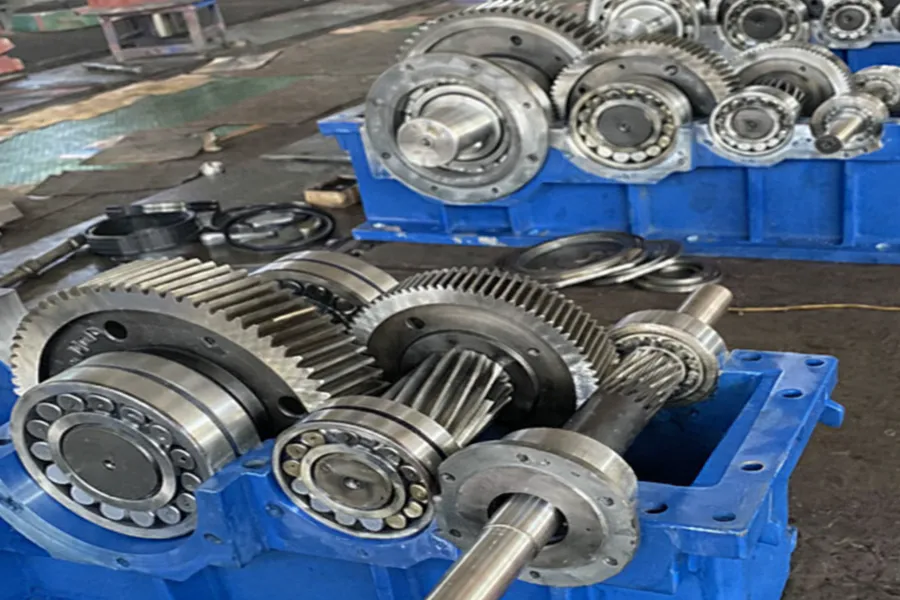
WorkShop
11. Related Products – Complete Driveline Solutions
The EP-TBS128 Grader Driven Rake Gearbox is one part of a full agricultural transmission ecosystem. Pairing the gearbox with driveline components designed for the same duty cycle ensures balanced service life across the entire power flow from tractor to implement rotor. This system approach avoids the mismatches that happen when mixed-source components are combined on a single implement – mismatches that typically show up as premature failure of the weakest link. Our product range includes rotary cutter gearboxes, fertilizer spreader gearboxes, rotary tiller gearboxes, post hole digger gearboxes, feed mixer gearboxes, square baler gearboxes, round baler gearboxes, universal PTO gearboxes, and hay tedder gearboxes alongside the grader driven rake series that includes the EP-TBS128 described here.
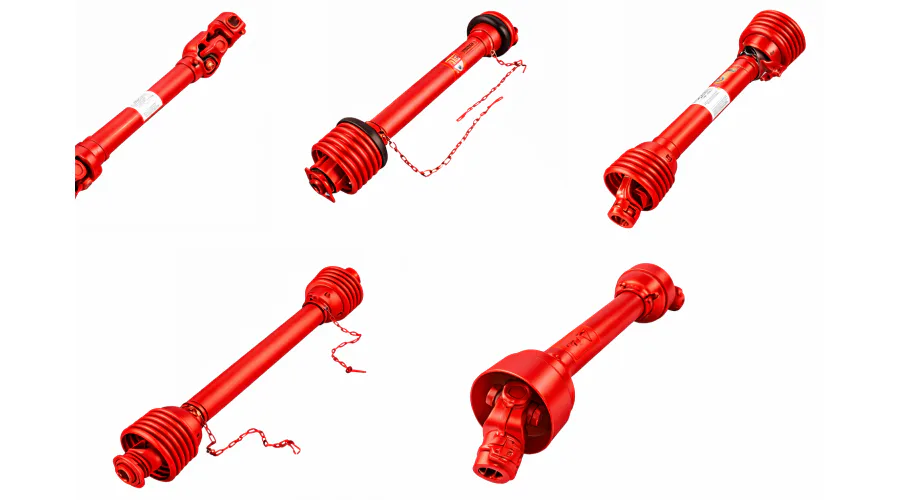
Matched PTO Shaft Assemblies
A good gearbox deserves a properly matched PTO shaft. Our catalog covers standard, wide-angle, and constant-velocity configurations with shear-bolt or friction-clutch overload protection, all supplied with fully compliant safety shielding per EU and Brazilian regulations.
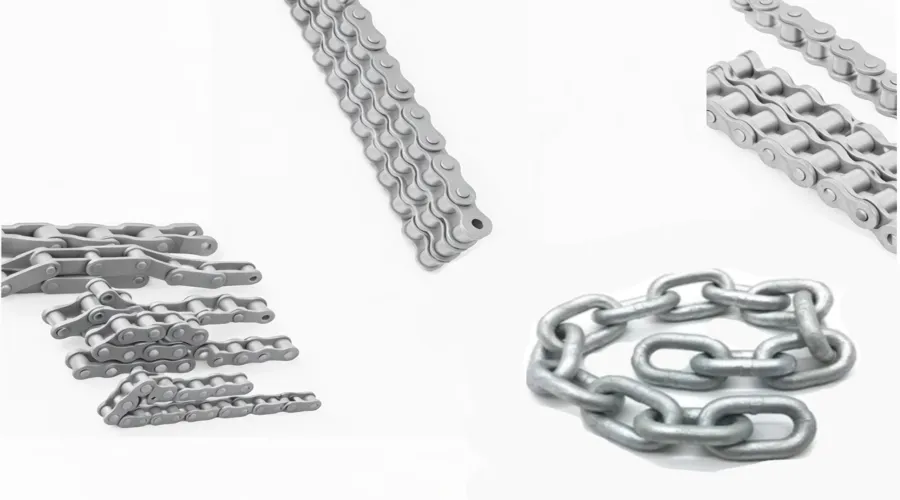
Chain Drive and Roller Chain Components
For cultivators that combine gearbox drive with secondary chain-driven subsystems – feeding reels, depth-control mechanisms, or auxiliary tool drives – we produce ANSI and DIN/ISO roller chains with induction-hardened pins and side plates. Common pitches in stock include #50, #60, and #80 series. When combined with the EP-TBS128 Grader Driven Rake Gearbox, these drive components form a coherent power delivery system with aligned maintenance intervals and compatible service parts.
Frequently Asked Questions About the EP-TBS128 Grader Driven Rake Gearbox
Q1: How does a grader driven rake gearbox work step by step on a crawler rotary cultivator used in Brazilian farming conditions?
A1: The process starts at the crawler tractor’s auxiliary drive output, which spins at 2400 RPM. A driveshaft carries this rotation to the EP-TBS128 Grader Driven Rake Gearbox input shaft. Inside the housing, two helical gear pairs sit ready, each with a different ratio. The operator’s shift collar selects one pair: gear 1 at 3.69:1 drops the output to 650 RPM with high torque for heavy clay work, and gear 2 at 2.81:1 produces 850 RPM with less torque for productivity on lighter soils. The selected output shaft then drives the cultivator rotor, whose tines engage the soil to perform the intended tillage task.
Q2: Which implement types besides crawler rotary cultivators can use the two-speed rake gearbox design with similar ratios and power ratings?
A2: The two-speed architecture is well-suited to any implement needing selectable rotor speed across variable soil conditions. Common applications include wheeled rotary tillers in the mid-power class, specialty-crop bed formers used in vegetable operations, vineyard inter-row cultivators, and certain grader-rake combinations used in parks and municipal landscape work. Any implement where the operator benefits from shifting between high-torque slow work and high-speed light work within the same field is a candidate. Always confirm flange pattern, shaft interface, and power rating match your specific equipment before specifying the unit.
Q3: What tractor horsepower range works best with a grader driven rake gearbox in the EP-TBS128 class of crawler cultivator transmissions?
A3: The EP-TBS128 Grader Driven Rake Gearbox is rated at 80 HP nominal and 100 HP peak, so it pairs well with crawler tractors delivering between 60 and 95 engine horsepower at the auxiliary output. Tractors at the lower end of this range (60 to 75 HP) load the gearbox well within its nominal rating, giving long component life and minimal thermal stress. Tractors at the upper end (80 to 95 HP) take full advantage of the peak rating for handling heavy clay or dense residue. Pairing the EP-TBS128 Grader Driven Rake Gearbox with tractors above 110 HP risks chronic overload during shock events and is not recommended without consulting our engineering team for an uprated alternative.
Q4: How should I store a grader-driven rake gearbox during the wet off-season in southern Brazil or Argentina to prevent corrosion and seal damage?
A4: Before off-season storage, run the gearbox for a few minutes so the oil warms and coats all internal surfaces, then drain and refill with fresh 80W-90 GL-5 oil to the correct level. Clean the exterior thoroughly of accumulated soil, plant residue, and dust. Apply a light corrosion-preventive spray to exposed machined surfaces, including the output shaft and flange faces. Store the implement in a covered, dry location; if outdoor storage is unavoidable, orient the unit so water cannot pool on the housing. Once a month, rotate the input shaft a few turns to redistribute oil across internal surfaces. At the start of the next season, check the oil level and inspect all seals before returning the unit to full-load service.
Q5: Which rake gearbox parts are most commonly replaced during routine service on a crawler-mounted rotary cultivator?
A5: The most frequently replaced service items are shaft seals (typically every 1,500 to 2,000 hours, depending on environment), tapered roller bearings (usually at 4,000 to 5,000 hours), gear oil (every 500 hours of operation), and the breather-valve filter element (annually or whenever visibly clogged). The gear pairs themselves rarely need replacement unless a severe overload event has occurred, because the carburized 20CrMnTi teeth are rated for a long service life under normal conditions. When ordering service parts, always confirm the gearbox model, serial number, and production year.
Q6: Why choose a grader-driven rake gearbox with two selectable gear ratios instead of a simpler single-ratio design for cultivator service?
A6: The practical benefit is operational flexibility. Field conditions rarely stay uniform over a full working day – soil moisture, residue load, and compaction vary across zones of the same paddock. A single-ratio gearbox forces the operator to compromise between speed and torque, but a two-gear unit like the EP-TBS128 Grader Driven Rake Gearbox lets the operator match rotor behavior to local conditions in real time. Gear 1 provides torque for tough spots, gear 2 provides productivity on easy sections. The result is better seedbed quality, lower fuel consumption, and reduced implement wear compared to running a single-ratio gearbox at a compromised middle setting.
Editor: PXY