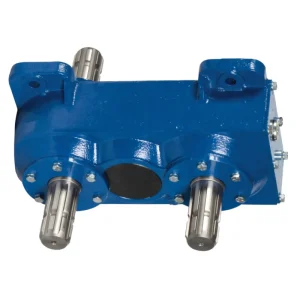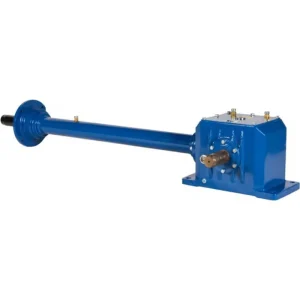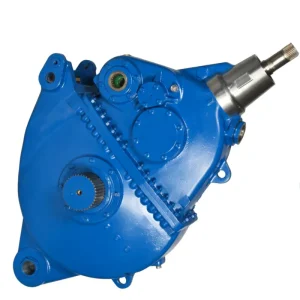
Description
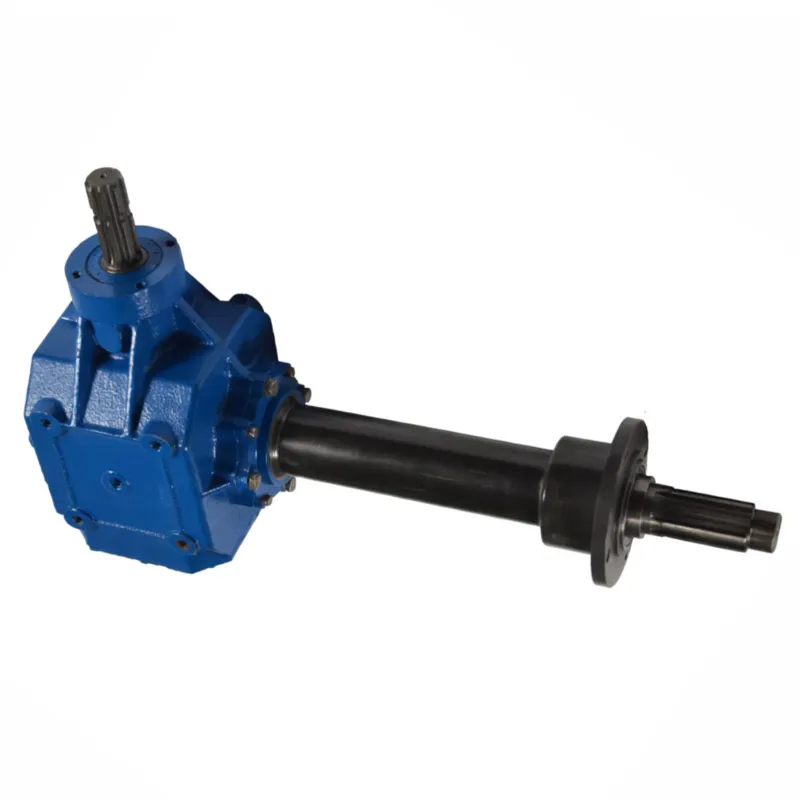
1. Grader Driven Rake Gearbox – Technical Specifications
The following table lists 20 verified technical parameters for the EP100 standard production specification. Custom shaft sizes, alternative gear ratios, and non-standard flange patterns are available upon written request. All values refer to bench-test conditions at 25°C ambient with fresh gear oil.
| Paramètre | Specification |
|---|---|
| Model Number | EP100 Grader Driven Rake Gearbox |
| Gearbox Type | Right-Angle Bevel Speed Increaser |
| Gear Ratio (i) | 1:2.31 |
| Vitesse d'entrée | 540 RPM (standard PTO) |
| Vitesse de sortie | 1250 RPM |
| Nominal Power | 100 HP (74.6 kW) |
| Maximum Power | 140 HP (104.4 kW) |
| Toothing Type | Gleason Spiral Bevel Teeth |
| Gear Material | 20CrMnTi Alloy Steel, Carburized |
| Tooth Surface Hardness | HRC 58–62 |
| Matériaux de construction | Gray Cast Iron HT250 (GB/T 1348-2009) |
| Bearing Type | Tapered Roller Bearings, 30200 Series |
| Bearing L10 Life | >5,000 hours at rated load |
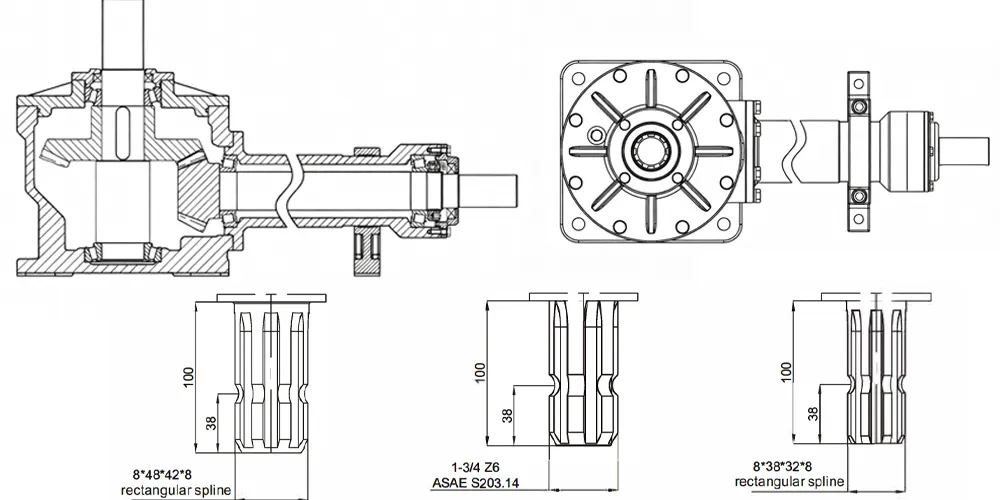
| Input Shaft | 1-3/8″ Z6 Splined, 35 mm diameter |
| Output Shaft | 40 mm diameter, Key 12 × 8 mm |
| Lubrication | 80W-90 GL-5 Gear Oil, Splash Feed |
| Capacité d'huile | 1.2 L |
| Operating Temperature | -20°C to +85°C |
| Protection Rating | IP54 (dust-protected, splash-resistant) |
| Overall Dimensions (L × W) | 397 mm × 226 mm |
| Net Weight | 28 kg |
| Mounting Flange | 4-Bolt Pattern, 140 mm PCD |
| Gear Accuracy Grade | AGMA Class 10 / DIN Grade 6 |
| Tooth Surface Roughness | Ra ≤ 0.8 μm |
| Noise Level (Rated Speed) | ≤ 72 dB(A) |
All specifications are indicative of the standard build. OEM integration drawings, 3D STEP files, and custom configuration quotes are available on request.
2. Fast Facts – EP100 Grader Driven Rake Gearbox for Rotary Tillers
● Gear Ratio: 1:2.31 speed increase – steps 540 RPM PTO input up to 1250 RPM output
● Power Rating: 100 HP nominal (74.6 kW) / 140 HP maximum (104.4 kW)
● Core Dimensions: Length 397 mm, Width 226 mm – compact for tight implement frames
● Primary Host Machine: Rotary tillers, grader-driven rakes, tine cultivators
● Personnalisation : Bespoke ratios, shaft splines, and flange patterns available per OEM drawing
3. What Is a Grader Driven Rake Gearbox and Where Does the EP100 Fit?
A grader-type rake gearbox is a right-angle bevel gear transmission unit whose specific job is to redirect and step up the rotational power coming from a tractor’s PTO shaft so it can drive the rake, tine, or rotor assembly mounted behind a rotary tiller or land-preparation implement. In simple field terms, it is the component that lets a tractor turn raw engine power into the quick, controlled rotation a rake needs to comb through soil and residue without bogging down. The EP100 Grader Driven Rake Gearbox occupies a middle-weight position in this category: it pairs naturally with tractors producing between 80 and 130 engine horsepower, a bracket that covers most medium-sized farms across Brazil’s São Paulo, Paraná, and Rio Grande do Sul grain belts, as well as horticultural and vineyard operators who need a reliable tillage companion that does not overpower small-frame implements. Its 1:2.31 speed-increase design is specifically calibrated so that a standard 540 RPM PTO shaft can push the tiller’s rake rotor up to the 1250 RPM window where rake tines work most efficiently on clay, silt, and mixed Brazilian oxisol soils.
Anyone asking what is a Grader Driven Rake Gearbox in practical language should think of the part as the translator between two very different mechanical worlds. On one side sits the tractor – powerful, slow-turning, and built to pull. On the other side sits the rake assembly – faster-spinning, hungry for torque peaks, and exposed to shock loads every time a tine strikes a rock or a compacted clod. The EP100 sits between these two worlds, absorbing shaft irregularities and cyclic impacts while maintaining a stable output speed. Inside the housing, a small input pinion with fewer teeth meshes against a larger output crown, producing the speed multiplication without drift or chatter. Farmers and dealerships considering a new rake gearbox unit typically compare three criteria: ratio accuracy, thermal headroom under continuous load, and seal integrity in dusty environments. The EP100 addresses all three by combining AGMA Class 10 gear quality, an oil-bath lubrication system with generous sump volume, and IP54-rated shaft seals developed for sustained agricultural exposure.
4. Five Key Advantages of the EP100 Rake Gearbox
1. Calibrated Ratio for Rotary Tiller Rake Performance
The 1:2.31 ratio is not a generic off-the-shelf choice – it was selected because rotary tiller rake rotors operate in a narrow efficiency band, and pushing them beyond that band wastes fuel while starving the tines of usable torque. By converting 540 RPM at the input to 1250 RPM at the output, the EP100 Grader Driven Rake Gearbox keeps the rake in its optimum speed window for chopping residue and fluffing seedbeds. Operators report smoother implement behavior and better ground contact when the rotor speed sits at this calibrated point, particularly in varying soil textures across Brazilian row-crop fields where moisture content can change dramatically within a single paddock.
2. Thermal Reserve for Long Working Days
The EP100 carries 100 HP nominal and up to 140 HP peak, giving it a 40 percent power reserve that absorbs short-duration torque spikes without overheating. This reserve matters because tiller rake operation is not steady – every rocky patch, buried stalk, or compacted ridge sends an impact up through the output shaft and into the gear train. A gearbox sized with no headroom will cook its oil and pit its gear teeth within one cropping season under these conditions. The EP100 Grader Driven Rake Gearbox’s generous oil bath, cast-iron housing, and oversized tapered roller bearings spread heat effectively, letting operators run 10-to-12-hour days during Brazil’s tight planting windows without watching the temperature gauge.
3. Sealed Housing for Dust and Moisture Exclusion
Agricultural tillage creates some of the harshest operating environments any gearbox will encounter – airborne silica, organic debris, humidity swings, and occasional rain. The EP100 Grader Driven Rake Gearbox uses a two-piece cast housing with machined flange surfaces, double-lip NBR shaft seals rated to IP54 protection, and a labyrinth design that traps contaminants before they reach the oil bath. This matters especially in Brazilian sugarcane and soy belts where fine red-dust ingress is the number-one killer of competitor gearboxes. The unit’s breather valve includes a micron filter that equalizes internal pressure during heat-up and cool-down cycles without admitting dust-laden air.
4. Straightforward Drop-In Replacement Geometry
Replacing a worn gearbox mid-season is a high-stress event – time is short, fields are waiting, and custom machining is rarely an option. The EP100 is dimensioned with standard agricultural interfaces: 4-bolt flange mounting, 1-3/8 inch Z6 splined PTO input, and keyed output shafts that align with common rotary tiller rotor configurations used across global OEM platforms. This makes it a realistic grader driven rake gearbox replacement candidate for many existing balers, tillers, and rake assemblies already in the field, reducing the need for adapter plates or rotor rework during swap-outs.
5. Built to International Quality and Safety Standards
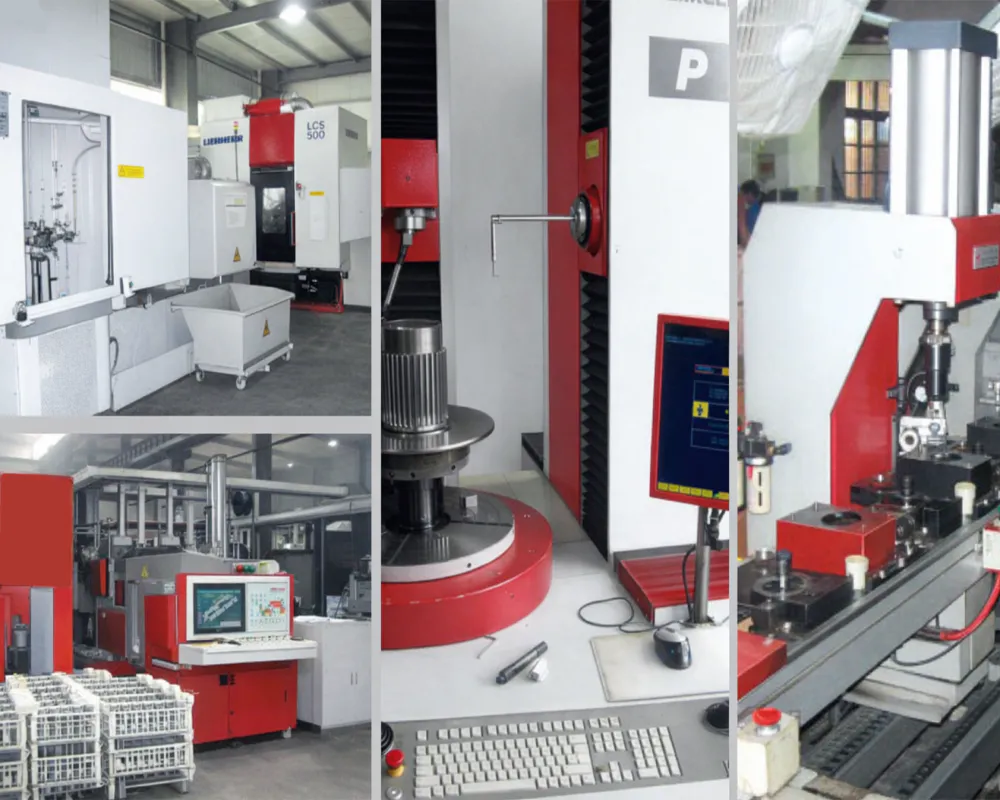
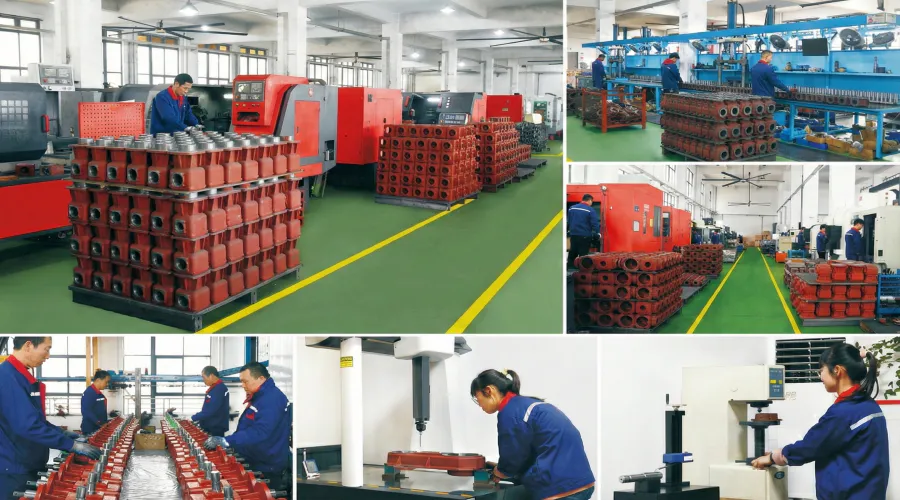
Every EP100 Grader Driven Rake Gearbox is assembled under an ISO 9001:2015 quality management system, with gear dimensions verified on coordinate measuring machines and each finished unit tested on a loaded run-in bench before shipment. For buyers serving the Brazilian market, the product design accounts for NR-12 (Norma Regulamentadora 12) machinery safety expectations, including documentation requirements in Portuguese and guarding references for exposed rotating components. For EU buyers, the design aligns with the Machinery Directive 2006/42/EC that underpins CE marking for agricultural equipment. This multi-standard design approach makes the EP100 a low-friction choice for distributors operating across regulated markets.
5. How the EP100 Rake Gearbox Works – Step by Step
Understanding how the grader-driven rake gearbox works starts at the tractor. Engine power leaves the tractor crankshaft, passes through an internal reduction, and arrives at the rear PTO stub spinning at a standardized 540 RPM. A splined PTO shaft couples this stub to the EP100 Grader Driven Rake Gearbox’s input shaft, carrying rotational energy from the tractor to the implement. The input spline is designed so that slight angular misalignment during travel does not generate binding – a common failure mode when operators lift the implement over headlands or cross uneven terrain. Inside the gearbox housing, the input shaft drives a small bevel pinion, typically 13 to 17 teeth, cut from case-hardened alloy steel. The pinion sits perpendicular to a larger crown gear mounted on the output shaft, and the two gear faces mesh at a 90-degree angle, accomplishing the right-angle direction change that makes the rake rotor’s horizontal axis spin from the tractor’s longitudinal axis. This is the structural essence of how grader driven rake gearbox works step by step.
Once the input pinion rotates the crown gear, the speed relationship is fixed by tooth count: fewer teeth on the pinion and more on the crown would slow the output down, but the EP100 Grader Driven Rake Gearbox is built the opposite way. Its tooth ratio produces a speed increase of 2.31 to 1, so every full turn of the input shaft yields 2.31 turns at the output. The output shaft, typically 40 to 45 mm in diameter with a machined keyway, extends out of the housing and couples directly to the rotary tiller’s rake rotor or tine assembly. When the operator engages the PTO at the tractor console, the rotor spins up quickly to 1250 RPM, driving the rake tines through the topsoil and accomplishing the seedbed, residue, and weed-management tasks the implement is designed for. During operation, the gears generate heat from friction and rolling contact – this heat is absorbed by the 80W-90 GL-5 gear oil in the sump, carried to the housing walls by splash circulation, and radiated to the surrounding air. The operator retains full control: disengaging the PTO clutch stops the gearbox input, which stops the rake rotor almost immediately thanks to low rotational inertia. This controllability is the reason farmers prefer gearbox-driven rakes over belt-driven alternatives for precision tillage tasks.
6. Materials and Metallurgy Inside the EP100 Grader Driven Rake Gearbox
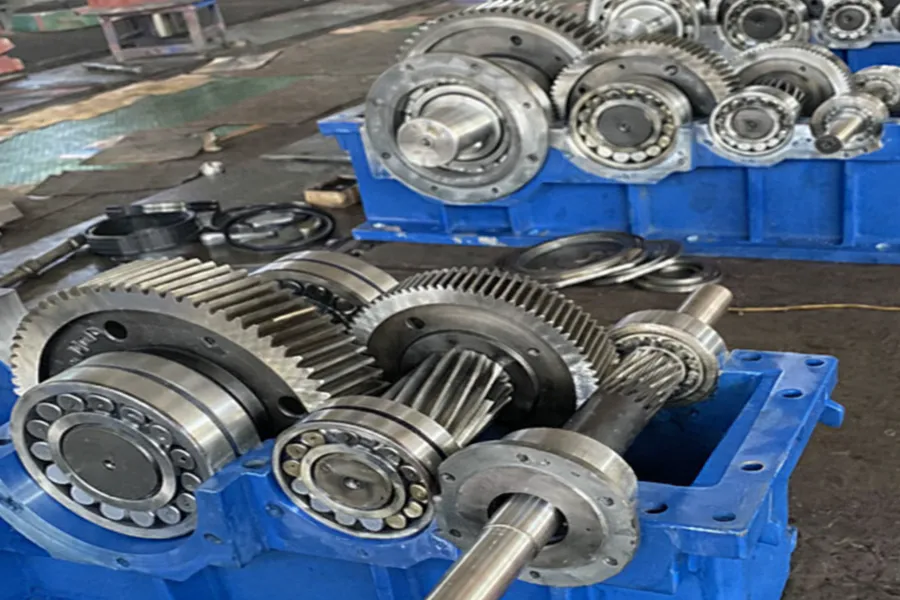
Gear material selection is the single biggest factor separating a long-lived agricultural gearbox from one that fails in its first season. The EP100 Grader Driven Rake Gearbox uses 20CrMnTi chromium-manganese-titanium alloy steel for both the input pinion and the output crown gear. This is a gas-carburizing grade specifically developed for high-contact-stress transmission components, and it strikes the balance that rake gearbox service demands: a case-hardened surface to resist pitting and micro-spalling from the rolling-sliding action between meshing teeth, and a tough ductile core that absorbs the shock loads generated every time a rake tine strikes a rock or compressed soil column. After CNC gear cutting on Gleason-type bevel generators, the gears undergo gas carburizing at approximately 920°C to a case depth of 0.8 to 1.2 millimeters, followed by oil quenching and low-temperature tempering. The result is a tooth surface hardness of HRC 58 to 62 with a core hardness around HRC 33 to 38 – the industry-accepted combination for agricultural bevel drives.
The housing is sand-cast from HT250 gray iron per Chinese national standard GB/T 1348-2009, a material chosen for three specific properties: excellent vibration damping (gray iron’s graphite flakes convert vibrational energy to heat), forgiving machinability for the precise bore seating that bearing installation demands, and dimensional stability under the sustained clamping loads of flange bolts. After casting, all critical surfaces – bearing bores, flange faces, shaft seal counterbores – are CNC-machined on horizontal machining centers to tolerances that keep gear mesh alignment within 0.05 mm across the output range. Shaft seals are double-lip NBR (nitrile butadiene rubber) type, selected for compatibility with 80W-90 gear oil and rated for continuous operation up to 100°C. Fasteners are grade 10.9 alloy steel, and all external surfaces are sand-blasted and finished with high-build epoxy primer plus agricultural-grade topcoat for corrosion resistance in humid tropical environments.
7. Where the EP100 Is Used – Field Application Scenarios
Seedbed Preparation for Row Crops
The EP100 Grader Driven Rake Gearbox shines in seedbed preparation for soy, maize, sorghum, and cotton – the four dominant row crops across Brazil’s central-west agricultural frontier. The 1250 RPM rotor speed at the output fluffs the top 10 to 15 centimeters of soil into a friable, uniform texture that accepts seed at precise depth without clumping or air pockets. Cooperatives in Mato Grosso and Goiás report significantly improved germination consistency when their rotary tillers run this speed-matched gearbox, because the rake tines leave behind a seedbed with uniform moisture distribution rather than the coarse, uneven finish produced by under-speed rotors.
Weed Control and Mechanical Cultivation
Growing herbicide resistance and organic certification demands have revived interest in mechanical weed control, and the EP100 Grader Driven Rake Gearbox-equipped rotary tiller is a leading tool for this task. The raking mechanism uproots young weeds by severing their root crowns near the soil surface, burying small weed seedlings under a shallow soil layer where they cannot access light. In Brazil’s growing organic vegetable sector and across vineyard row-middle management operations in Europe, this mechanical approach is increasingly favored over chemical alternatives, and the consistent rotor speed delivered by the gearbox is what makes the cultivation effective without damaging crop root zones.
Crop Residue Incorporation
After sugarcane, wheat, and maize harvests, fields are left covered in crop residue that must be either removed or incorporated into the soil to release nutrients and make room for the next crop. Rotary tillers driven by the EP100 Grader Driven Rake Gearbox chop and mix this residue into the top soil layer in a single pass, accelerating decomposition through better soil contact and improved aeration. Brazilian ethanol producers working with sugarcane straw particularly benefit from this pathway, as the tilled residue builds soil organic matter over seasons rather than being burned off in the open.
Pasture Renovation and Horticulture
Livestock operators use EP100-equipped tillers to renovate degraded pastures by breaking up compacted grazing zones, incorporating lime or organic amendments, and preparing the ground for overseeding with improved forage varieties. In horticulture and landscaping, the same gearbox powers smaller rotary units that prepare planting beds for nursery stock, ornamentals, and vegetable crops. The moderate power rating of 100 HP nominal makes the EP100 Grader Driven Rake Gearbox a strong choice where mid-sized tractors are the norm – something you see constantly in Brazilian small-holder and family-farm operations.
8. International Regulations and Certification Landscape
Selling agricultural gearboxes into Brazil means engaging with NR-12 (Norma Regulamentadora 12), the federal machinery safety standard administered by the Ministry of Labor. NR-12 is one of the most actively enforced safety regulations in Latin America and applies across the full machinery lifecycle: design, manufacturing, importation, sale, operation, and decommissioning. For a rake gearbox, the practical NR-12 implications include guarding specifications for exposed rotating shafts per ABNT NBR ISO 13855 safety distances, Portuguese-language user manuals covering installation, operation, and maintenance, safety labels applied to the machine itself, and proper torque and lubrication instructions. Non-compliance triggers real commercial consequences: labor inspectors can issue immediate equipment embargo orders (interdição), and administrative fines range from R$2,000 to over R$200,000 per machine depending on risk severity. Beyond NR-12, INMETRO (National Institute of Metrology) certification may apply in specific product categories.
Outside Brazil, each major export destination brings its own regulatory framework. The European Union requires CE marking under the Machinery Directive 2006/42/EC, which mandates a risk assessment per ISO 12100, a Declaration of Conformity, and user documentation in the destination-country language. The United States applies OSHA machine guarding regulations under 29 CFR 1910.147, along with ANSI/ASABE standards such as ANSI/ASABE S318 for agricultural equipment shielding. Canada follows CSA Z432 machinery safety standards with provincial-level enforcement. Australia uses AS 4024 for safeguarding of machinery. Argentina applies IRAM standards that closely parallel ISO references. The EP100 Grader Driven Rake Gearbox is designed with reference to ISO 12100 (safety of machinery – general principles of design), ISO 6336 (gear load capacity calculation), and AGMA 2003 (bevel gear rating), giving it a strong technical baseline that satisfies the requirements of most regulated agricultural markets with only region-specific labeling and documentation additions.
9. Installation and Maintenance Practices for Long Service Life
Proper installation begins before the EP100 Grader Driven Rake Gearbox ever leaves its shipping crate: verify the PTO shaft length, confirm the flange bolt pattern matches the tiller frame, and check that the gear oil sight glass reads within the marked range. Mount the gearbox on a clean, flat face using four Grade 10.9 bolts tightened to 85 Nm in a cross-pattern sequence. Align the input shaft with the tractor PTO stub so that the working angle during operation stays below 15 degrees – beyond this angle, universal joint wear accelerates sharply and transmits vibration into the input bearings. Couple the PTO shaft with the locking collar fully engaged, install all safety shields before engaging power, and run the assembled implement at low PTO speed for five minutes to let gear oil circulate and seals seat properly. Check for any leakage at the input and output seal zones before putting the unit into full-load service.
Routine maintenance follows a simple schedule tied to operating hours. Drain and replace the gear oil after the first 50 hours of break-in service, then every 500 hours thereafter or at the start of each new season. At each oil change, inspect the magnetic drain plug for metallic particles – a light film of fine particles is normal, but visible chips or flakes indicate accelerated internal wear that warrants further investigation. Check shaft seal condition at least twice per season, looking for hardened lips or weepage that signals end-of-life. Inspect the housing breather valve and clean it if dust has accumulated – a blocked breather can pressurize the housing during operation and force oil past the shaft seals. Keep the exterior of the gearbox clean by brushing off accumulated soil and vegetation before storage, as trapped organic matter holds moisture against the housing and accelerates corrosion. Store the implement in a covered location when not in use, and rotate the PTO shaft a few turns periodically during long off-season periods to redistribute oil across internal surfaces.
WorkShop
10. Related Products – One-Stop Agricultural Drive Solutions
The EP100 Grader Driven Rake Gearbox is part of a complete ecosystem of agricultural transmission components that we design to work together. Pairing the gearbox with matched PTO shafts, torque limiters, sprockets, and replacement tines gives you a coordinated drive system where every link in the power transmission chain is sized and specified for the same duty cycle. This one-stop approach simplifies procurement, avoids the mismatches that plague mixed-source implement builds, and puts technical support for the entire driveline in a single team. Our agricultural gearbox catalog extends across rotary tiller gearboxes, rotary cutter gearboxes, feed mixer gearboxes, round and square baler gearboxes, post hole digger gearboxes, fertilizer spreader gearboxes, and universal PTO gearboxes – alongside the rake gearbox series that includes the EP100 Grader Driven Rake Gearbox.
Matched PTO Shaft Assemblies
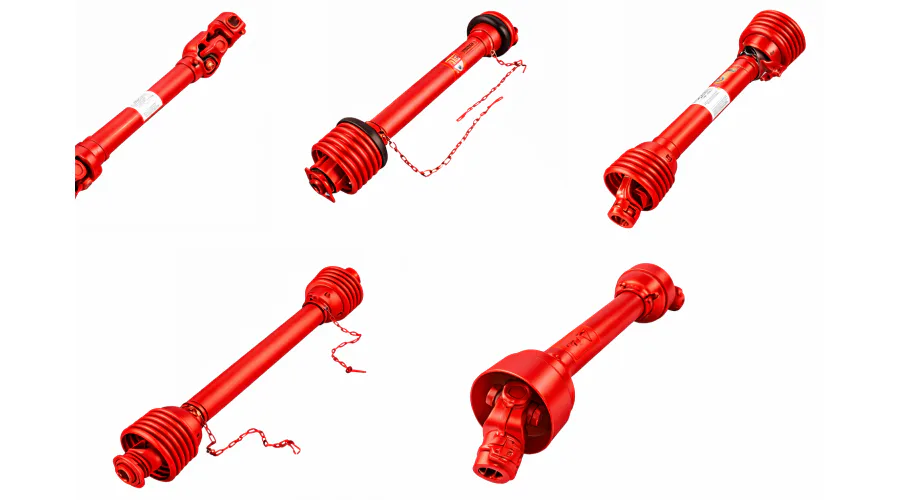
PTO shafts are the critical link between tractor and implement. Our catalog includes standard, wide-angle, and constant-velocity configurations with shear-bolt or friction-clutch overload protection, sized to match the EP100 Grader Driven Rake Gearbox’s 1-3/8 inch Z6 splined input. Shafts ship with full safety shielding compliant with EU and Brazilian regulatory requirements.
Precision Sprockets and Drive Components
For implements that combine gearbox drive with secondary chain-driven subsystems, we produce sprockets and roller chains to ANSI and DIN/ISO standards with induction-hardened tooth surfaces for extended life. Common pitches in stock include #50, #60, and #80 series, covering most agricultural chain applications. When matched with the EP100 Grader Driven Rake Gearbox, these components form a cohesive power transmission system with synchronized service intervals.

Frequently Asked Questions About the EP100 Grader Driven Rake Gearbox
Q1: How does a grader driven rake gearbox work step by step on a rotary tiller powered by a 540 RPM tractor PTO?
A1: The process runs in sequence. The tractor’s PTO stub rotates at 540 RPM and transmits this rotation through a splined PTO shaft into the gearbox’s input shaft. Inside the housing, a small pinion on the input shaft meshes with a larger crown gear mounted at 90 degrees on the output shaft. Because the pinion has fewer teeth than the crown, the ratio is 1:2.31, so the output shaft spins 2.31 times faster than the input – reaching 1250 RPM. The output shaft drives the rotary tiller’s rake rotor, which engages the soil to perform the intended tillage task.
Q2: Which tractor horsepower range works best with a rake gearbox for rotary tillers like the EP100 Grader Driven Rake Gearbox?
A2: The EP100 Grader Driven Rake Gearbox is rated at 100 HP nominal and 140 HP peak, making it a strong match for tractors delivering between 80 and 130 engine horsepower at the PTO. Tractors at the lower end of this range (80 to 100 HP) will load the gearbox well within its nominal rating, yielding long component life and minimal thermal stress. Tractors at the upper end (110 to 130 HP) take advantage of the 40 percent power reserve for handling heavy residue or compacted soils. Pairing the EP100 Grader Driven Rake Gearbox with tractors above 140 HP risks chronic overload during shock events and is not recommended.
Q3: How can I verify that a rake gearbox for sale is genuinely compliant with Brazilian NR-12 machinery safety requirements?
A3: Compliance verification has practical steps. First, request the supplier’s technical documentation package and confirm that installation and operation manuals are provided in Portuguese as required by NR-12 clause 12.128. Second, check that the supplier can provide a risk assessment document aligned with ISO 12100 methodology, which NR-12 references. Third, verify that safety labels and guard mounting points are present on the physical product. Fourth, for installations in Brazil, confirm that a local CREA-registered engineer can issue a Laudo de Validation and ART (Anotação de Responsabilidade Técnica) document after installation, as these are required for legal operation.
Q4: Why choose a grader driven rake gearbox with a speed-increaser design rather than a reduction gearbox for rotary tiller applications?
A4: Rotary tiller rake rotors operate most efficiently in a speed range higher than the standard 540 RPM PTO output, which is why a speed-increase design is preferred. The 1:2.31 ratio in the EP100 Grader Driven Rake Gearbox brings the output to 1250 RPM, matching the aerodynamic and mechanical optimum for rake tine soil engagement. Running the rotor below this optimal range causes incomplete soil cutting, excessive drag, and poor residue chopping. A speed-reducer would push the rotor in the wrong direction entirely and be unsuitable for this task – hence the speed-increase gearbox is the correct architecture for rotary tiller rake drive.
Q5: Which rake gearbox parts are most commonly replaced during routine field service and maintenance?
A5: The most frequently replaced service items are shaft seals (typically every 1,500 to 2,000 hours depending on operating conditions), tapered roller bearings (usually 4,000 to 5,000 hours), gear oil (every 500 hours), and the housing breather valve filter (annually or when visibly clogged). Gears themselves rarely need replacement unless there has been a severe overload event, because the case-hardened 20CrMnTi teeth are designed for long service life. When ordering service parts, always confirm the gearbox model, serial number, and production year to ensure a correct fit.
Éditeur : PXY